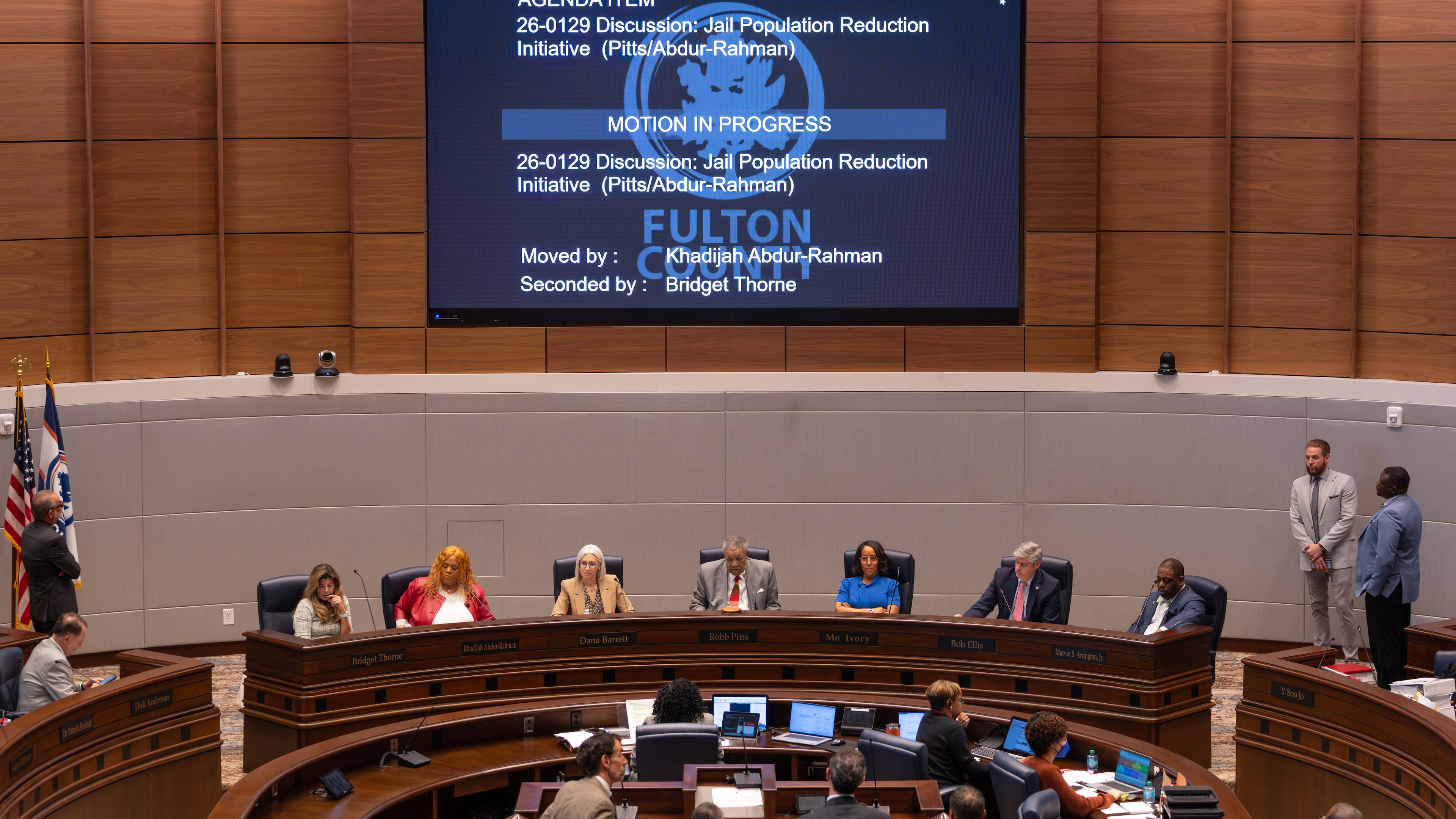
The Fulton County Board of Commissioners voted 4-1, with one abstention, on Wednesday, July 15, to oppose Atlanta's plan to extend six tax allocation districts that would divert an estimated $3 billion in property tax revenue over 30 years away from county services.
For Johns Creek residents, those county services include courts, public safety, public health, elections, and senior programs funded almost entirely by property taxes.
District 1 Commissioner Bridget Thorne, who represents Johns Creek, voted in favor of the resolution.
Bipartisan opposition
The measure was co-sponsored by Vice Chairman Bob Ellis, a District 2 Republican, and District 6 Democrat Khadijah Abdur-Rahman. It declares the county's opposition to Atlanta's Neighborhood Reinvestment Initiative and sets a new rule: any future county participation in a TAD will require five votes on the seven-member board, not a simple majority.
Commissioner Dana Barrett, who sits on the Invest Atlanta board of directors, abstained. Before the vote, Barrett said any future county participation should be negotiated "TAD-by-TAD" with new rules and a framework around any potential extension. The identity of the single dissenting vote was not specified in available meeting records.
What's a TAD and why it matters here
A tax allocation district diverts growth in property tax revenue away from government entities into a separate fund used to promote redevelopment. About 85% of Fulton County's revenue comes from property taxes.
The county's annual contribution to Atlanta's existing TADs grew 232% between 2012 and 2025, reaching approximately $53 million in 2025, according to the resolution. The cumulative 13-year total: $413 million diverted from county services.
The Atlanta City Council approved the Neighborhood Reinvestment Initiative on Monday, June 15, extending six TADs through 2056. With full county and school system participation, Mayor Andre Dickens' plan would generate $5 billion to $7 billion over three decades. The six districts are Westside, Eastside, Campbellton Road, Hollowell-Martin Luther King Jr., Metropolitan Parkway, and Stadium.
Constitutional and legal concerns
Ellis told fellow commissioners the extension violates Georgia's Constitution and would impose a "huge" tax burden on citizens.
"A declination of this is just plain, good, sound fiscal policy," Ellis said at the July 15 meeting. "At a state level, there's a continued discussion on compressing property taxes. So the concept of locking yourself into something that may be compressed when you're heavily dependent upon one source of revenue, also is a scary financial proposition."
According to the resolution, Atlanta's own auditor confirmed the TAD extension violates a state law capping the taxable value of property within all existing TADs in a city at 10%. Atlanta's existing TADs represent about 16% of the city's total taxable property base.
In April 2026, the Georgia Office of Legislative Council ruled that the extension constitutes the creation of a new district, meaning the tax increment baseline must be reset to current assessed property values.
Competing obligations
The resolution cited unfunded county obligations that compete with TAD-diverted revenue: $50 million for compliance with the jail system's federal consent decree, $1.1 billion for a new 1,800-bed jail facility and renovations, and $300 million for a South Fulton hospital partnership with Grady Memorial Hospital.
What happens next
Atlanta now needs Atlanta Public Schools to agree to the extension for the NRI to proceed. APS contributes about half the revenue in most TADs. Without the school system's participation, the initiative would shrink from $5 billion to $7 billion down to approximately $1.4 billion. No APS board vote has been scheduled as of July 17.
The Fulton County Board of Commissioners meets the first and third Wednesday of each month at 10 a.m. Meetings are live-streamed on FGTV, and residents can participate in public comment in person or virtually via Zoom.